
Sandblasting aluminum is nothing like blasting steel, and treating it the same way is how good boats get ruined. Aluminum is soft. It scars, pits, and warps long before steel would even notice the nozzle. Around Lake City we see more aluminum than most towns our size — jon boats that live on the Suwannee and the Santa Fe, pontoon logs, diamond-plate toolboxes, trailer skins running the I-75 corridor. Done right, blasting strips paint and corrosion off aluminum clean and quick. Done wrong, it turns a straight panel into a potato chip. Here are the honest dos and don’ts from a crew that blasts a lot of aluminum in Columbia County — and has fixed a few other people’s mistakes.
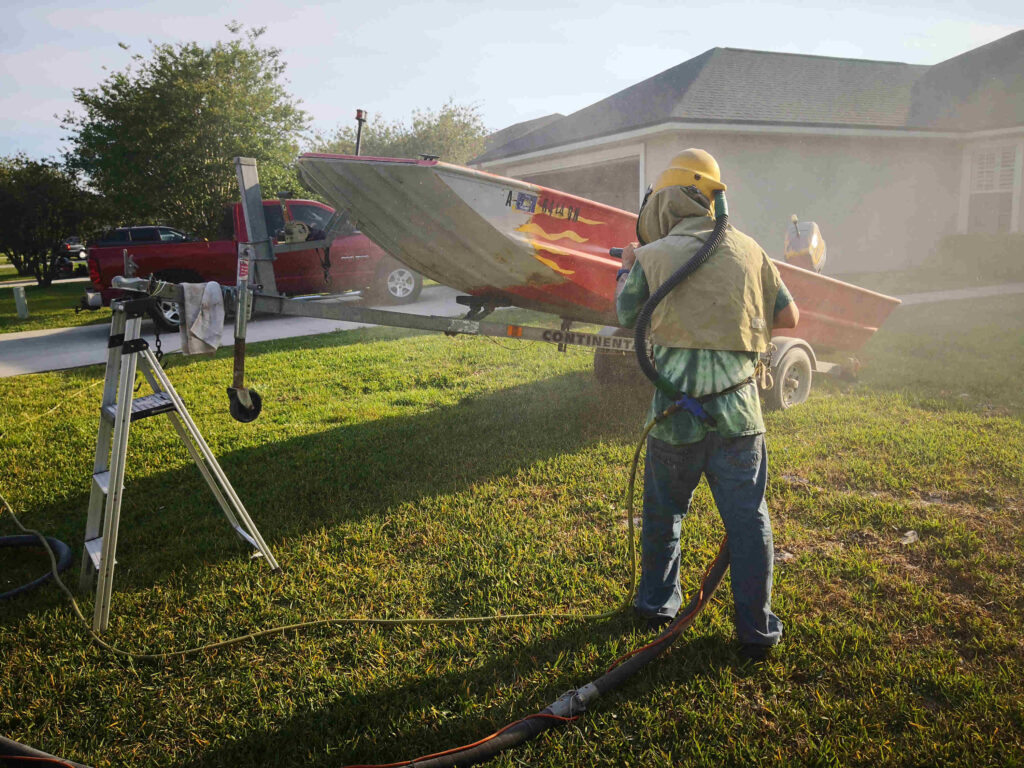
Why sandblasting aluminum is a different animal
Steel forgives. You can lean on a trailer frame with coal slag at 100 psi and it just gets cleaner. Aluminum does not forgive. It is soft enough that the same media and pressure that put a nice tooth on steel will dig craters in an aluminum skin, and the heat that builds up under the blast can ripple a thin panel — what the trade calls oil-canning — before you have finished one side.
There is a second problem you cannot see. Blast aluminum with the wrong media — anything carrying iron — and you drive microscopic steel particles into the surface. Aluminum and steel do not get along once moisture shows up. Those embedded particles become tiny corrosion batteries, and a few months of Florida humidity later the surface breaks out in white pits right under the new paint. On a boat that spends its weekends at a river landing, that is not a maybe. It is a schedule.
And while aluminum does not flash rust the way bare steel does, it is not patient either. It starts rebuilding its oxide skin within hours, and paint bonds poorly to stale oxide. The clock between blast and primer matters just as much as it does on steel — it is just quieter about it.
The dos of sandblasting aluminum
- Degrease before you blast. Blasting over oil, old gas residue, or river slime does not remove it — it hammers it deeper into the metal, and no primer sticks to that. Solvent wipe or hot wash first, every time.
- Drop the pressure. Where steel might take 90–100 psi, aluminum usually wants 40–70 depending on thickness. A pontoon log takes less than a thick cast housing. Pot pressure is a decision made at the job, not a default left over from the last one.
- Use a fine, iron-free media. Glass bead, crushed glass, or soda. More on that below, because this choice makes or breaks the whole job.
- Keep the nozzle moving at a shallow angle. Parked straight-on in one spot is how craters happen. Sweep it like spray painting, 30–45 degrees off the surface, and let the media do the work.
- Test a hidden spot first. A transom corner, the inside of a toolbox lid. Thirty seconds of testing tells you what an hour of guessing will not.
- Prime the same day. Self-etching or epoxy primer while the surface is fresh. We blast and coat with the same crew for exactly this reason.
That last one deserves its own sentence. The worst failures we get called to look at in metal sandblasting work around Lake City are usually not blast failures at all — they are surfaces that sat bare for a week before anyone got around to primer.
The don’ts
- Don’t use coal slag or steel grit. Both are cheap, both are everywhere, and both embed iron in the surface. That is fine on a steel I-beam and a slow disaster on an aluminum hull.
- Don’t use silica sand — on anything. Blasting with actual sand throws respirable crystalline silica into the air, and OSHA’s abrasive blasting guidance is blunt about what that does to lungs. Any outfit still loading play sand in the pot is telling you what they think of safety.
- Don’t lean in on thin skins. Boat hulls, trailer siding, and toolbox lids often run a sixteenth of an inch or thinner. Close-up, perpendicular blasting warps them with heat and peening, and there is no un-warping a panel.
- Don’t blast anodized aluminum expecting it to look new. Blasting removes anodizing; it does not restore it. You get clean, matte, bare aluminum that needs a coating. Usually that is exactly what the job wants — but know it going in.
- Don’t leave it bare. The oxide layer rebuilds fast, and adhesion drops with every day the metal sits gray and naked.
- Don’t ask blasting to fix corrosion that has gone through. If white powdery corrosion has eaten holes in a pontoon or a transom bracket, that is a welder’s conversation first. Then ours.
The right media: what we actually load for aluminum
Media choice is most of the battle in sandblasting aluminum, so here is how we pick, in plain terms.
Glass bead is the gentleman of the pot. Round instead of sharp, it peens the surface clean and leaves a soft satin finish. It is our pick for wheels, castings, outboard housings — anywhere the finish itself matters. Crushed glass is bead’s rougher cousin: sharp, inert, iron-free, and it cuts old bottom paint and thick coatings off a hull without embedding anything that will pit later. Soda is the gentlest of all — it strips paint and grease and will not touch the metal underneath, which makes it the right call for delicate hulls and engine parts. That is a big enough subject that our soda blasting service in Lake City has its own page. Aluminum oxide earns a spot when a coating spec calls for real etch — used sparingly, at low pressure, by someone paying attention.
Same price either way — we pick the media by the job site, never by the invoice. And on jobs tight to a house or a dock, we can run the work wet: our dustless blasting rig knocks the dust down, though wet aluminum needs drying and a quick move to primer.
Aluminum jobs we see around Columbia County
Living in river country means aluminum everywhere. Jon boats and bass boats coming off the Suwannee and Santa Fe landings with ten years of bottom paint and oxidation. Pontoon logs that have gone chalky. Diamond-plate toolboxes and headache racks on work trucks running I-75 and Highway 90. Aluminum trailer skins, loading ramps, farm gates and panels out toward Fort White and Wellborn. The rig is mobile — it comes to your driveway, barn aisle, or boatyard, and most of these jobs are blasted and primed before supper.
When you should not hire us
Here is the honest part most people skip. If you have one carburetor, a couple of small brackets, or a single wheel, a benchtop cabinet at a machine shop — or a Scotch-Brite pad and a Saturday — will do you fine. And if your hull is corroded through, spend the money at the welder first. We would rather tell you that on the phone than charge you to hear it in person. The honest no is how we earn the next yes.
Sealing it up: the part that makes the blast worth it
Fresh-blasted aluminum is the best painting surface you will ever get on this metal — for a very short window. Self-etching or epoxy primer needs to go on within hours, because North Florida humidity does not take days off, and neither does that oxide layer. We handle blast and coating with one crew, same day, and our painting services in Lake City can carry the job through topcoat so the finish matches the prep. One crew, no finger-pointing.
We are licensed and insured, and the person who answers the phone is the person holding the nozzle. Need sandblasting in Lake City or nearby? Call (386) 400-1904 for a free on-site estimate. You will reach someone who actually does the work.