
Boat bottom paint removal is the job most boat owners around Lake City put off until the hull looks like a topographic map. One season you roll on a fresh coat of antifouling, the next season you roll another over the top, and eight years later there is an eighth of an inch of dead paint flaking off in sheets at the ramp. Whether you run the Suwannee out of Branford, fish the Santa Fe below Fort White, or trailer down I-75 for Gulf trips, the fix is the same: every failed layer has to come off so the next coat has something solid to grab. Here are six honest answers about how that actually happens — including when you should not pay us to do it.
1. Boat Bottom Paint Removal: Do You Actually Need It This Year?
Here is the honest part most people skip: not every hull needs to go back to bare surface. If your bottom paint is a season or two old, still bonded tight, and only worn thin at the waterline and the leading edges, a scuff and a fresh compatible coat will do fine. Save your money and go fishing.
Full removal earns its keep in three situations. The old paint is cracking, blistering, or peeling in sheets, so anything you roll over it peels right along with it. Nobody knows what is on the hull — you bought the boat used, the previous owner is vague, and new paint will not stick to a mystery. Or the layers are simply so thick they are adding weight and drag and shedding chips every time the boat sits on the trailer. If a scraper, some sandpaper, and a Saturday will genuinely handle your hull, we will tell you that on the phone. The honest no now earns the yes when the job is real.
2. What Your Hull Is Made Of Matters More Than the Paint
The paint decides almost nothing about how we work. The hull decides everything.
Fiberglass is the common case on the Suwannee and Santa Fe — bass boats, center consoles, cruisers. Under the antifouling sits a thin gelcoat, and often an epoxy barrier coat you paid good money for and want to keep. Aggressive media at high pressure will cut through both before you can blink. That is why a fiberglass bottom is a low-pressure, fine-media job where control matters more than speed. Anybody who quotes it like blasting a dump trailer should make you nervous.
Aluminum jon boats and pontoons are a different animal. The metal is soft, heavy media can embed in it or warp thin panels, and the wrong approach does more harm than the old paint ever did. We match media to the metal — the same discipline we use on any metal sandblasting job in Lake City.
Steel hulls and steel workboat bottoms are rare in Columbia County but they exist, and they bring one extra problem: bare steel in North Florida humidity starts flash rusting before supper. Steel gets blasted and primed the same day, no exceptions.
3. Soda, Dustless, or Sand: Picking the Right Method
Soda blasting is the gentle option. Sodium bicarbonate breaks down layers of antifouling without chewing into gelcoat, it will not warp aluminum, and it rinses away clean. The honest trade-off: soda leaves a residue that must be washed off completely before anything gets recoated, or the new paint will not stick, and soda will not touch heavy rust or deep pitting.
Dustless blasting wraps the media in water, which knocks the dust plume down and strips thick, stubborn multi-layer bottoms fast. The trade-off there is the wet slurry — it is a muddy mess that has to be contained and cleaned up, and it is not the tool for delicate gelcoat.
Dry blasting with a fine abrasive covers the rest — steel hulls, trailers, and hardware that need a real anchor profile for primer.
We do not upsell one over the other. Same crew, same rig — we pick by the hull, never by the invoice, and we will tell you straight which one your boat wants.
4. The Honest Part: Old Antifouling Is Nasty Stuff
Antifouling paint works because it is loaded with biocides — usually copper compounds designed to poison the barnacles and slime trying to live on your hull. That does not stop being true when the paint dries out and starts flaking. Attacking it in the driveway with an orbital sander puts that dust in your lungs, your lawn, and everything parked nearby.
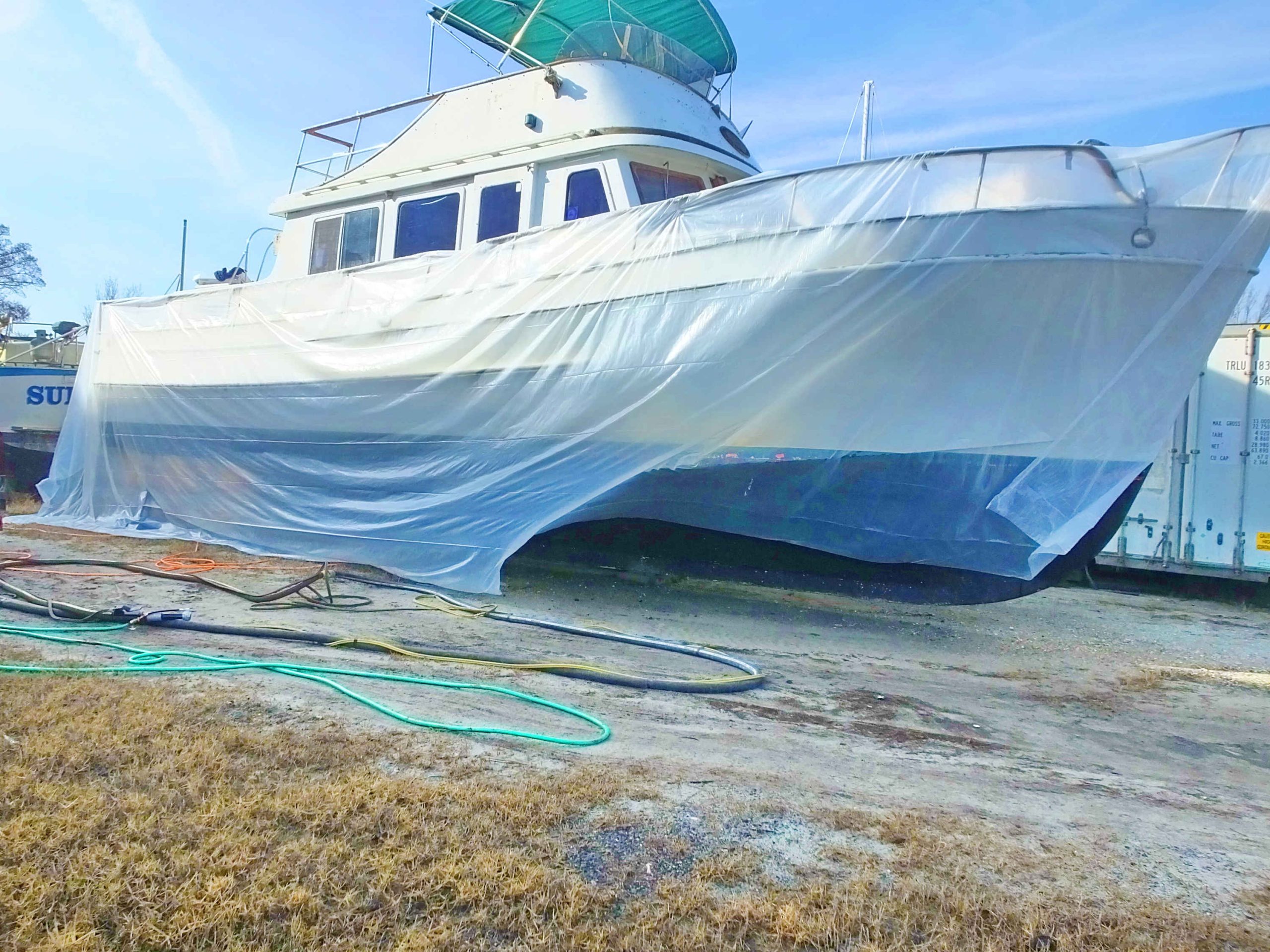
Done right, boat bottom paint removal is a contained job: tarps and containment under the hull, spent media and paint chips captured and disposed of, and the operator in proper respiratory protection following OSHA’s abrasive blasting guidance. This is one of those jobs where the money saved doing it yourself is not worth what you breathe doing it.
5. What Happens Right After the Paint Comes Off
A bare hull is a decision point, not a finish line.
On fiberglass, this is your one clean look at the laminate. We inspect for blisters and soft spots while everything is exposed — far cheaper to find them now than after two fresh coats. A bare fiberglass bottom usually wants an epoxy barrier coat before new antifouling goes on, especially on a boat that lives in the water at a dock instead of on a trailer.
On aluminum and steel, the clock starts immediately. Bare metal out here does not wait for the weekend — it wants primer the same day it gets blasted. That is the quiet advantage of one crew that blasts and coats: no scheduling gap between stripping and priming and painting, no week of surface rust forming while you wait on a second contractor.
6. How the Job Actually Runs
Most bottom jobs around here go like this. The boat sits on its trailer or on stands with room to work underneath. We mask the waterline, thru-hulls, transducers, trim tabs, and zincs. Then we strip the bottom with whichever method the hull called for, wash it down, and walk the hull with you to look at what the paint was hiding. If coatings are part of the job, primer or barrier coat goes on before the surface has a chance to spoil.
A trailerable bass boat or jon boat is typically a one-day strip. A bigger cruiser or a thick forty-year buildup can run two. The rig is mobile — we come to your place off US-90, your barn outside Fort White, or a boatyard, anywhere between Lake City and the river towns with room to set up containment. No hauling your boat to us and leaving it in a stranger’s lot for a month.
Why Bottom Paint Has a Harder Life in Columbia County
Our water is not marina water, and that changes how paint dies. The Suwannee and Santa Fe run tannic and acidic — that dark tea color is real chemistry, and it works on coatings season after season. Spring runs near Ichetucknee and Troy Spring add another wrinkle: clear, mineral-heavy water and the limestone shoals and sandbars that come with it. Every soft grounding on a shoal scrapes a little antifouling off the keel and chines, and every scrape is a place where the next layer starts letting go.
Then there is how boats live around here. Most Columbia County hulls sit on trailers in full sun between weekends, not in a wet slip. Antifouling is built to stay wet; repeated wet-dry cycling and Florida UV make some formulas chalk and crack years early. A boat that splits time between the river and Gulf runs out of Suwannee or Steinhatchee gets the worst of both — fresh water, salt water, and highway miles of vibration in between. None of this means you need blasting every few years. It means that when the paint does start letting go around here, it tends to let go all at once — and patching over it stops working sooner than the forums promise.
Straight Answers, Then a Clean Hull
Boat bottom paint removal is not complicated, but it punishes shortcuts — wrong media eats gelcoat, skipped containment poisons the driveway, and slow priming lets flash rust undo a day of work. Get the method matched to your hull and the recoat done on time, and the bottom will outlast several seasons of Suwannee sandbars.
Lake City Sandblasting | (386) 400-1904 | https://lakecitysandblasting.com/
Need sandblasting in Lake City or nearby? Call (386) 400-1904 for a free on-site estimate. You will reach someone who actually does the work.