
A fellow off a county road near Fort White called about his shop floor. Years ago somebody rolled gray porch paint over the slab, and now it was peeling in sheets, with black tire marks welded into what was left. He had already tried a rented grinder and a bucket of store-bought stripper. He had a sore back and a floor that looked worse. This is the honest rundown on concrete paint removal: what actually works, what only makes a mess, and when a blast rig is the wrong call.
Why Concrete Paint Removal Is Harder Than It Looks
Concrete is not a flat sheet of plastic. It is a hard, porous stone full of tiny pits and capillaries. When paint goes on, it soaks into those pores and locks in mechanically. That is why a scraper skates across the top and leaves the stubborn part behind.
Add Florida to the mix. Our slabs sit on damp ground, and moisture pushes up through the concrete all year. That vapor is the number one reason coatings peel in Columbia County. The paint did not fail because somebody was lazy. It failed because water had a path and the film had no way to let it out.
So the real job is not just getting paint off. It is getting the paint out of the pores and leaving a clean, open surface that the next coating can grip. That distinction decides which method you pick.
Method One: Blasting for Concrete Paint Removal
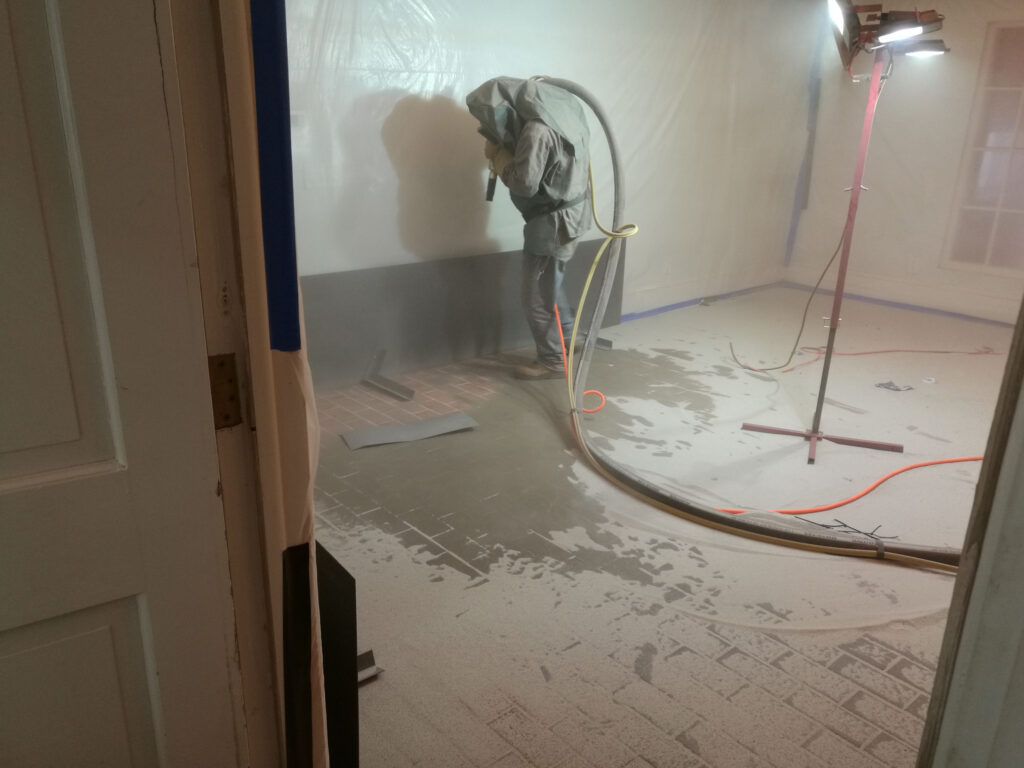
Abrasive blasting is the method that reaches into the pores. A stream of media hits the surface, knocks the coating loose, and lightly opens up the top layer of the slab. Done right, you end up with bare, textured concrete that is ready for a sealer, stain, or a new coating.
Here is the honest part most people skip: concrete is softer than steel, so you do not blast it the way you blast a trailer frame. Pressure, media size, and nozzle distance all get dialed down. Push too hard and you etch the slab into a rough, uneven mess that shows through any thin finish. A good operator watches the surface the whole time and backs off the second the paint is gone.
If you want to understand the process in detail, our concrete sandblasting in Lake City page walks through how we handle slabs, driveways, and block walls.
Method Two: Dustless Blasting for Concrete Paint Removal
Dustless blasting adds water to the stream so the dust is knocked down at the nozzle. For concrete paint removal near a house, a pool cage, or a neighbor’s fence, that matters. You get the same stripping action with far less airborne dust drifting across the yard.
Now the downside, because there always is one. Wet blasting leaves a slurry. On a slab, that muddy film has to be rinsed and the surface has to dry fully before anything gets coated. In Florida humidity, drying takes longer than people expect. It trades one problem for another. We will tell you straight which one your job wants. You can read the full trade-offs on our green and dustless blasting page.
Method Three: Soda Blasting for Delicate Spots
Not every painted concrete surface wants aggressive media. Soda blasting uses baking-soda-based media that is much gentler. It lifts paint and grime without cutting deep into the surface, which makes it a fit for decorative concrete, stamped patios, and areas right beside windows, plants, or finished trim.
The trade-off is speed. Soda works well on thin coatings and lighter films. It struggles with thick, multi-coat buildup or heavy epoxy. If your slab has three layers of floor paint stacked over each other, soda alone will take forever. See our soda blasting in Lake City page for where it shines.
Glue, Mastic and Old Adhesive on Concrete
Paint is only half of the story. Pull up old vinyl tile or carpet and you usually find black mastic or stubborn glue baked onto the slab. Some of the older adhesives were also made with materials that are not safe to grind or sand into dust. If the building is old and you are not sure what is under the floor, stop and get it tested before anything gets disturbed. The EPA has clear guidance on lead-safe work practices at epa.gov, and it applies to painted surfaces in older buildings.
When the adhesive is confirmed safe to remove, blasting handles it better than a scraper. A scraper smears thick glue. Abrasive media breaks it up and carries it off the surface. The slab still needs a clean, dry finish before any coating goes down, and that is where most do-it-yourself jobs go wrong.
When a Grinder or Stripper Is the Better Call
We are not going to pretend blasting is right for every slab. If you have a small closet floor, a single step, or a thin coat of paint in one corner, a rented grinder or even a wire brush and a Saturday may be all you need. We will tell you that on the phone and save you the trip.
Chemical strippers have a place on small, vertical areas. For concrete paint removal across a big slab they are slow, smelly, and hard to rinse out of the pores. Whatever you leave in the concrete can interfere with the next coating. Grinders are fast on flat floors, but they throw heavy dust and cannot reach corners, edges, or textured surfaces. Blasting wins when the surface is large, rough, patterned, or full of tight spots a grinder cannot touch.
What Happens After the Paint Is Gone
Concrete paint removal is not the finish line. Bare concrete in this climate is thirsty and open. A few things matter right away:
- Let the slab dry. Moisture inside the concrete will lift a new coating again. Give it time, especially after wet blasting or a rainy week.
- Test for moisture. A simple plastic-sheet test taped to the slab overnight tells you a lot. If you see condensation underneath, the slab is still pushing vapor.
- Coat promptly. An open, unsealed surface collects dirt, oil, and mildew fast in North Florida air.
- Match the coating to the use. A shop floor, a pool deck, and a carport all want different systems.
Because we blast and coat with the same crew, we handle that handoff ourselves. If you want a fresh finish on the surface once it is stripped, our painting services in Lake City cover it, so nobody is pointing fingers at the last person when something peels.
Safety and Rules You Should Know About
Abrasive blasting throws dust and debris, and it is regulated for a reason. Silica is the big one. Concrete contains crystalline silica, and breathing the dust is a serious health hazard. OSHA covers the hazards and controls at osha.gov/abrasive-blasting, and a professional crew handles containment, protective gear, and cleanup as a matter of routine.
That is one more reason not to hand a rented blaster to a weekend helper. The paint is the small problem. The dust is the real one. And if the building was painted before the late 1970s, lead has to be on the table before a single grain of media is fired.
How to Decide What Your Concrete Paint Removal Job Needs
Walk the surface and ask yourself four plain questions:
- How many coats are there? One thin coat is a different job than five layers of floor paint and epoxy.
- Is the paint peeling or stuck? Peeling paint on a damp slab points to a moisture problem you need to fix first.
- How big is the area? Big and rough favors blasting. Small and smooth favors a grinder.
- What goes on next? The next coating decides how clean and how textured the slab has to be.
If you cannot answer those from the driveway, that is fine. Describe what you see and we will give you a straight read. Sometimes the answer is that your slab needs a drainage fix and a dry summer, not a blast rig.
Mobile Service Across Columbia County
The rig comes to you. We work in Lake City and across Columbia County, from the I-75 corridor out to farm country, river lots, and small-town properties around Fort White, Live Oak, and Branford. We run on your site, set up around your landscaping and structures, and clean up when we are done.
For bigger projects or surfaces we have not seen, we will look at it first. You can also see how we approach prep work in our surface preparation guide, which explains the standards behind the work. Concrete paint removal is a surface prep job at heart, and surface prep is what decides whether the next coat lasts two years or twelve.
Need sandblasting in Lake City or nearby? Call (386) 400-1904 for a free on-site estimate. You will reach someone who actually does the work.