
If you have a project car sitting under a carport off US-90, you already know the hard part is not the engine. It is the body. And the question that stops most Columbia County restorations cold is how to get sixty years of paint, filler and rust off sheet metal without warping it into scrap. That is where dustless blasting car restoration earns its reputation — and where it also gets oversold. Here is the honest version, from people who run the rig.
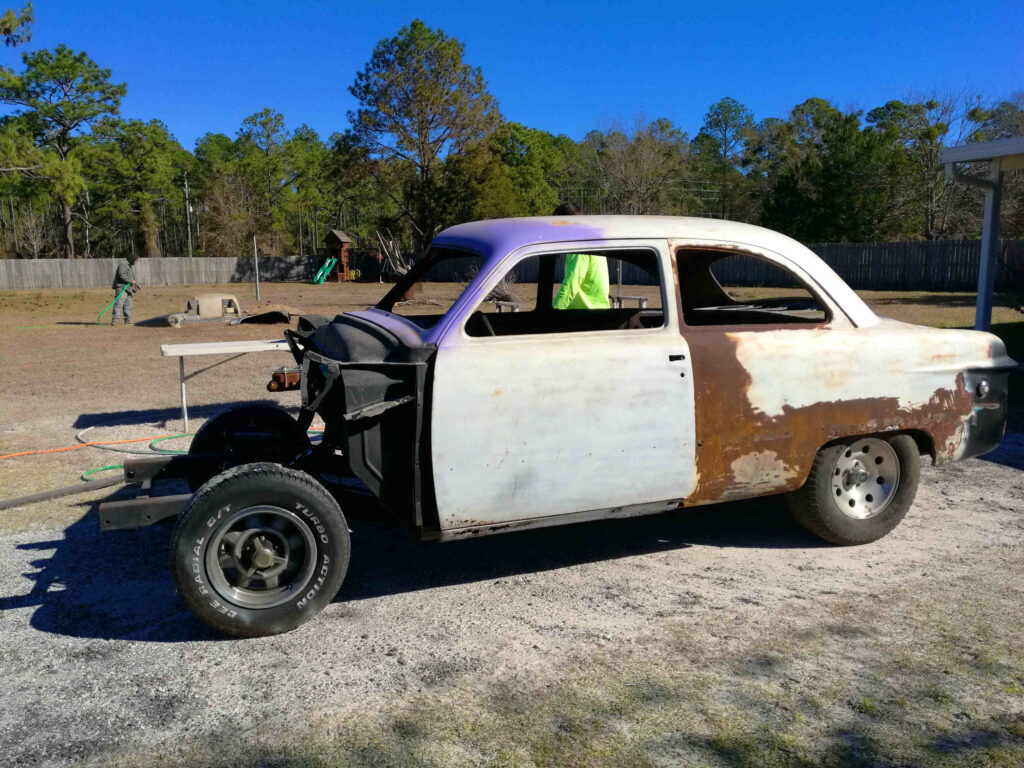
1. What dustless blasting car restoration actually does to a body panel
Dustless blasting — wet blasting, vapor blasting, whatever the sticker on the trailer says — is abrasive and water fired through the same nozzle. The water does two jobs. It knocks down the silica dust that a dry rig throws, and it adds mass to each particle so you can cut paint at lower pressure.
That second part is the whole reason it matters on a car. Sheet metal on a 1950s pickup cab can be twenty gauge or thinner. Dry blasting at high pressure on thin steel builds heat fast, and heat is what oil-cans a quarter panel. Wet media carries heat away as it works. You can hold the gun on a door skin longer before anything moves.
What it does not do is turn a rusted-through floor pan into good metal. Blasting removes coatings and corrosion products. It reveals the truth about the panel underneath. On a lot of North Florida cars — especially anything that spent time near the Suwannee or sat in a field off CR-240 — that truth is holes. We would rather you see them now than after you have paid for paint.
2. Yes, there is a mess, and we will not pretend otherwise
The word "dustless" does a lot of marketing work it did not earn. There is less airborne dust. There is more slurry. Wet media plus stripped paint equals a gritty mud that goes everywhere gravity takes it — inside rockers, into frame rails, under the cowl, into every seam a body has.
On an open field job that mud washes off. On a car it has to be chased out, because slurry left in a box section will hold moisture against bare steel for years. We blow out, flush, and blow out again. It adds time. Anybody who tells you a car body blasts and rinses in an afternoon has either never done one or is not telling you what happens in month six.
Our take: for large flat panels, hoods, roofs and doors off the shell, wet is often the better tool. For a fully assembled body with the seams still closed, we will usually push you toward dry work with tight media control, or toward pulling the shell apart first. Same price either way — we pick by the job, not the invoice. If you want the full comparison, we wrote it up on our dustless and green blasting page.
3. Flash rust is not a defect. It is a clock.
Strip a panel wet in Lake City in July and it will bloom a light orange haze while you are coiling the hose. That is flash rust. It is normal, it is shallow, and it is the single biggest reason people get a bad result from a good blast.
Two ways to handle it. A holdback additive in the blast water buys you a window — usually hours, not days, and less than that when the humidity sits where it sits along the I-75 corridor in August. Or you accept the haze, knock it back with a light dry pass or a scuff, and prime immediately.
Either way the rule does not change: bare steel gets primed the same day. Not next weekend. Not when the paint guy has an opening. Bare metal here starts flash rusting before supper, and every hour you leave it open is profile you are losing. We run blasting and coating with the same crew for exactly this reason — the panel does not sit around waiting on a second company schedule. You can see how we handle the coating side on our painting and coating services page.
4. Media choice decides whether the panel survives
The media matters more than the machine. A few honest rules from doing this on real cars:
- Crushed glass or fine garnet — the workhorses for steel body panels. Aggressive enough to cut old enamel and factory primer, fine enough to leave a profile paint actually likes.
- Coal slag — cheap, fast, and too hot for thin sheet metal. Fine on a frame or a trailer tongue. Keep it off your quarter panels.
- Soda — the gentle option. It will not touch good paint or warp anything, which makes it right for aluminum trim, brightwork, engine parts and cars where you want to strip a topcoat without going to bare steel. It also leaves a residue that has to be neutralized before primer. More on that on our soda blasting page.
- Glass bead — peens rather than cuts. Great for a satin finish on small parts, poor as a paint stripper.
Aluminum deserves its own warning. Plenty of classics have aluminum trim, valve covers, or in a few cases entire panels. Hit aluminum with steel-friendly media at steel-friendly pressure and you will embed abrasive in it and stretch it. Different media, lower pressure, different operator mindset.
5. The prep you do before we show up changes the outcome
A car is not a gate. Every opening is a place for media and slurry to go, and every piece of glass and chrome is a thing that cannot be un-frosted. Before a body goes under the gun:
- Strip it further than feels necessary. Glass, trim, weatherstrip, lights, badges, door cards, wiring. Anything you mask instead of remove is something you are gambling on.
- Pull the drivetrain and interior, or seal them like you mean it. Media finds carburetors. It finds seat tracks.
- Drain and open the low points. Slurry has to have somewhere to leave. Plugged drains turn a rocker into a mud reservoir.
- Decide what stays original. If there is good factory paint or a stamping you do not want softened, tell us before, not during. We can mask it or switch media.
- Have primer on site. Same-day priming only works if the primer is already there.
On frames, suspension brackets and anything thick, we swap approaches entirely and treat it as structural steel work — see our metal sandblasting page for how that side runs.
6. When we will tell you not to blast it at all
The honest no list, because it saves everybody money:
Fiberglass and composite panels. Corvettes, some kit bodies, aftermarket hoods. Blasting opens the weave and you will spend more filling it than you saved stripping it. Chemical or sanding work is the right call.
Body filler you want to keep. If a previous repair is solid and you are only doing a color change, blasting will dig it out and hand you a new repair.
A single small patch. If it is one fender and a wire wheel and a Saturday afternoon will do it, do it yourself. Mobilizing a rig for that is not a good trade for you.
A car with lead filler in the seams. Older bodies used lead at roof and quarter joints. Blasting it is a health issue, not just a technique issue, and it belongs in the same conversation as old lead-based paint. The OSHA guidance on abrasive blasting hazards is worth reading if you plan to do any of this in your own shop — containment, respiratory protection and waste handling are not optional details.
A body that is more rust than metal. Sometimes the kindest thing we can say is that blasting will confirm what you are afraid of. We will still tell you.
Why Columbia County cars are their own animal
Cars here live a specific life. Humidity that barely drops overnight. Salt from coastal trips and none of the road salt that eats Midwest cars, so rust here comes from the bottom up and the inside out rather than the fenders in. Barn and pole-shed storage with a dirt floor, which is a moisture pump aimed straight at your floor pans. Trucks that pulled boats to the Suwannee and the Ichetucknee for thirty years and carry the evidence in the rear frame rails.
That is why we look at underside and structure before we get excited about the paint. A gorgeous strip on a body with soft rails is money spent in the wrong order. And it is why we bring the rig to your shop or barn in Lake City, Fort White, Live Oak or Branford rather than asking you to trailer a half-apart car across the county — a shell with the glass out does not travel well.
The short version
Dustless blasting car restoration is a real advantage on thin sheet metal, mostly because water controls heat and dust. It is not magic, it makes a mud you have to chase, and it starts a flash-rust clock the second the water hits steel. Match the media to the panel, prep the car further than feels necessary, and prime the same day. Do those three things and you get a shell a painter is glad to see.
We will tell you straight which approach your car wants, including when the answer is not this one.
Need sandblasting in Lake City or nearby? Call (386) 400-1904 for a free on-site estimate. You will reach someone who actually does the work.