
Somebody tagged your wall. Maybe it’s the back of a storefront off Marion Avenue, a block wall behind a warehouse near the I-75 interchange, or a box culvert out toward Fort White. Whatever they hit, you want it gone — and you’ve probably already learned that rolling cheap paint over a tag just gives the neighborhood a gray rectangle that says “graffiti was here.” Graffiti removal sandblasting takes the paint off instead of hiding it. Done right, the wall looks like nothing ever happened. Done wrong, it leaves a scar uglier than the tag. Here are six honest answers about graffiti and coating removal in Lake City and Columbia County — including the parts most outfits won’t say out loud.
1. Will Graffiti Removal Sandblasting Work on Brick Without Wrecking It?
Honest answer: it depends entirely on the brick. Modern hard-fired brick shrugs off a careful blast. The older soft brick you see on some of the storefronts in downtown Lake City is another story. That brick has a thin fired skin on its face, and everything behind that skin is softer. Blast too aggressive and you cut through the skin — the brick starts drinking water, the face gets fuzzy, and every year after that it sheds a little more of itself. You traded a tag for a wall that’s slowly dissolving.
So on brick, we do what we always do: a test patch in a low spot, fine media, low pressure, and we look at what the wall tells us. Mortar joints are softer than the brick around them, so we watch those too. If the test patch says the brick can’t take it, we tell you straight and point you at a gentler route instead of taking your money and leaving scars. That’s the same approach we take on every brick and masonry blasting job in Lake City — the wall sets the rules, not the machine.
2. What About Concrete, Block, and Metal?
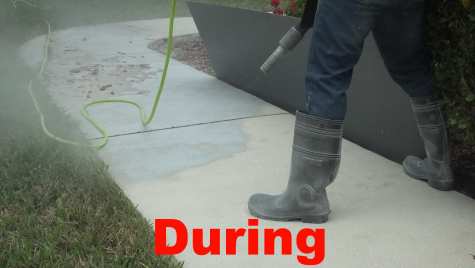
Concrete and block are friendlier targets. Spray paint sits down in the pores of the surface, and a light blast opens those pores and lifts the paint out. Tilt-wall warehouse panels, retaining walls, curbs, sidewalks somebody decorated overnight, the block wall behind a gas station — this is bread-and-butter work, and it’s most of the graffiti calls we get along the I-75 and US-90 corridor. A careful pass takes the paint and leaves a clean, uniform surface that’s actually better prepped for a coating than it was before. If the slab or wall is getting a new coating afterward, that’s the same prep we run on any concrete sandblasting job in Lake City.
Metal is a different game. Roll-up doors, dumpsters, utility boxes, trailer sides, sign panels — paint comes off steel clean, but thin sheet metal holds heat and warps if you lean on it. We keep the media fine, the angle shallow, and the dwell time short. And here’s a practical truth: on a dumpster or a roll-up door, it’s often smarter to blast and repaint the whole panel than to chase one tag and leave a clean spot that doesn’t match twenty years of sun fade. We’ll tell you which one your job wants.
3. Why Does a Faint Shadow Sometimes Stay?
Here is the honest part most people skip. Spray paint is mostly solvent, and porous masonry drinks solvent. On a hot Florida wall, that paint flashes off fast and the pigment wicks down into the pores — deeper than any blast can reach without eating the wall itself. So on some block and brick, you get 95 percent of the tag gone and a faint ghost where the darkest color went in deepest. It’s called shadowing, and anyone who promises you a porous wall will look factory-new every time is either new at this or lying to you.
When a ghost stays, you’ve got two honest options. You can chase it deeper — which costs wall surface and usually isn’t worth it — or you can knock the shadow down and put a matched coating or sealer over it, which makes it disappear for good. We look at the surface, tell you which way it’s likely to go before we start, and let you decide. No surprises after the compressor is already running.
4. Which Media Do We Pick for Graffiti Jobs in Columbia County?
There’s no one abrasive for graffiti, because there’s no one wall. Crushed glass or fine garnet at turned-down pressure handles most masonry. For delicate substrates — aluminum panels, thin skins, surfaces where any profile is too much — soda blasting strips coatings without biting the base material. And for a storefront that’s still open for business, wet or dustless blasting keeps the dust cloud down so you’re not chasing customers off the sidewalk while we work. Same price either way — we pick by the job site, never the invoice.
Two safety notes worth knowing. Abrasive blasting is a regulated activity — OSHA has specific rules about silica, containment, and protective equipment, which is one reason this isn’t a rent-a-pot weekend job. And if the coating under the graffiti is original paint on a building from before 1978, it can carry lead. We test before we blast, because grinding lead paint into the air next to your front door helps nobody.
5. When Should You NOT Blast Graffiti?
Sometimes the right answer is to leave our rig parked. We’d rather lose a job than mislead you, so here’s when blasting is the wrong call:
- One tag on a painted wall you like. Blasting takes everything — the tag and the paint around it. A spot treatment with a chemical graffiti remover and a matched touch-up coat is faster and cheaper.
- Soft historic brick that fails the test patch. If the wall can’t take it, we say so. A scarred hundred-year-old facade is forever.
- A wall that’s getting repainted anyway. If the surface is sound, a stain-blocking primer and a topcoat may be all you need. If a wire brush, a primer, and a Saturday will do it, we’ll tell you.
- A fresh tag on a sealed surface. If the wall was sealed with an anti-graffiti coating, a pressure wash can lift the tag right off. Don’t pay for a blast you don’t need.
The honest no is the reason our phone rings twice. The customer we turn away in March calls back in June with a job that actually needs us.
6. What Stops the Next Tag From Sticking?
Getting the graffiti off is half the job. Keeping the wall easy to clean next time is the other half, and it’s the half most people never hear about. Anti-graffiti sealers come in two flavors: sacrificial coatings that wash off — tag and all — with hot water, and permanent coatings that let solvent-based paint wipe away without soaking in. On bare masonry there’s an extra reason to seal: a freshly blasted wall is thirsty, and in North Florida humidity it will drink the next storm if you leave it open.
If the plan is repaint rather than seal, color matching matters more than people think. A wall repainted in its true, matched color makes any future cover-up invisible — no checkerboard of almost-gray rectangles. We blast and we coat, same crew, same trip, which means the wall goes from tagged to blasted to primed to finished without three contractors pointing fingers at each other. That’s the whole pitch behind our painting services in Lake City — the guy who prepped the surface is the guy standing behind the coating on it.
One Wall or a Whole Building — One Call Does It
We’re mobile, so the rig comes to you — downtown Lake City, the industrial parks along I-75, a church in Fort White, a barn wall out toward Branford or Live Oak. Licensed and insured, and the person who answers the phone is the person who runs the blast pot, so you’ll get a straight answer about whether your wall needs a blast, a wash, or just a good primer. Send a photo of the tag if you want — it usually takes about a minute of looking to know which way the job wants to go.
Need sandblasting in Lake City or nearby? Call (386) 400-1904 for a free on-site estimate. You will reach someone who actually does the work.