
Here is the honest part most people skip on pool deck coating prep: the coating never fails because of the paint you buy. It fails because of what was still on the concrete when you rolled it on. We get called out to Columbia County pool decks and patio slabs every summer where a homeowner bought a good epoxy or elastomeric coating, watched it look great for six months, then watched it peel, bubble, or go chalky in patches. Almost every time, the problem started before the first coat ever touched the slab. This post walks through the five steps that actually matter, where we draw the line and tell a customer to save their money, and what to watch for on coping stone and pool edges specifically.
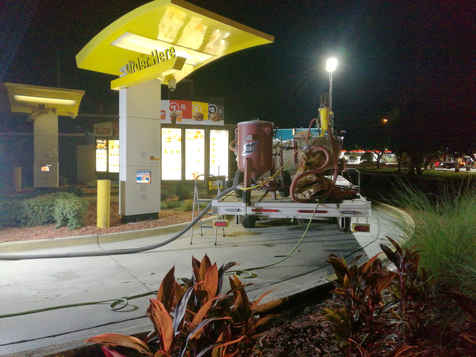
Why pool decks and patio slabs fail coatings so fast around Lake City
Columbia County sits in a spot where humidity, chlorine, algae, and hard water all land on the same eight feet of concrete around a pool. A patio slab off I-75 gets a different beating — pollen, tannin stains from oak leaves, and the fine red clay dust that blows in off a dirt driveway. Either way, the surface is rarely just “concrete.” It is concrete with a film on it, and that film is exactly what a new coating bonds to instead of the slab underneath.
Add in the fact that a lot of pool decks around here were broom-finished or stamped, and you get a surface with texture that traps old sealer and grime deep in the low spots. A pressure washer knocks the surface clean. It does not touch what is packed into the pores. That is the gap between a deck that looks ready and a deck that actually is ready.
Pool deck coating prep: the 5 steps we actually follow
None of these steps are optional if you want the coating to last more than a season. Skip one and you have built a nice-looking problem for next summer.
1. Strip old paint, sealer, and efflorescence down to bare concrete
Old acrylic sealer, peeling deck paint, and the white chalky efflorescence that rises out of concrete near a pool all have to come off completely — not just dulled down. Media blasting takes a slab back to sound, open concrete without the gouging a grinder leaves or the water intrusion a chemical stripper can cause. For a pool deck or patio in Columbia County, concrete sandblasting is usually the fastest way to get a slab down to bare material in one visit, without soaking the ground next to a pool in stripper runoff.
2. Deal with mildew, algae, and pool chemical staining first
If the deck has ever stayed wet in the shade — under a covered lanai, behind a pump house, along a fence line — there is almost always mildew or algae staining working down into the surface, not just sitting on top of it. Blast over that without addressing it and you trap organic growth under your new coating, where it keeps feeding and eventually pushes the coating right back off. We knock this out as part of the same blasting pass rather than treating it as a separate chemical step, which saves a trip and keeps harsh cleaners off the pool equipment.
3. Open the surface profile so the new coating can grip
This is the step people skip most, and it is the one that matters most. A coating needs a surface profile — a slightly rough, toothy texture — to mechanically lock into. A slab that looks clean but is still smooth and closed will let a coating sit on top instead of bonding into it. That is why a pool deck coated over a pressure-washed-only surface so often fails at the edges first, right where foot traffic and pool water work at it hardest. Blasting opens that profile evenly across the whole slab, corners included.
4. Let it dry completely before anything goes back down
Concrete holds moisture longer than it looks like it should, especially a slab poured near a pool or low ground near the Santa Fe or Suwannee floodplain. Coat over damp concrete and you get a hazy, milky finish at best, and blistering at worst as trapped moisture tries to work its way out through a sealed coating. We give a slab real drying time before priming, not just until it looks dry on top.
5. Fix cracks and spalling before you coat, not after
A hairline crack under an old sealer is invisible until you strip the deck down — then it is staring right at you. Patch and fix cracks, chips, and spalled edges before the coating goes on. A coating is not a crack filler. It will telegraph right through and often crack again at the exact same spot within a year, because the movement in the slab never stopped.
Coping stone and pool edges need a gentler touch
The flat field of a pool deck can take a straightforward media blast, but the coping stone right at the pool edge is a different animal. Cantilevered concrete coping, brick coping, and travertine or shell-stone edging chip and pit easily if you hit them with the same pressure and media you would run across an open slab. On those edges, and on any decorative stamped border, we often step down to soda blasting instead. Soda media is soft enough to strip old sealer and grime off coping and tile without eating into the stone or rounding off a stamped pattern you want to keep. Running one abrasive over the whole job because it is faster is how a coping edge ends up looking sandblown and dull next to the field it is supposed to match.
Timing the job around Columbia County weather
Late spring and early fall are the best windows for pool deck work out here. Summer brings afternoon thunderstorms almost like clockwork, and a coating needs a clean cure window without rain rolling through by 3 p.m. Humidity also slows cure time on most coatings, so a job started under a rushed deadline before a pool party is more likely to trap moisture and blister early. We would rather push a start date back a few days for a dry stretch than rush a coat onto a slab that has not had time to breathe. That is a small delay against a coating that is supposed to last five to seven years.
When pressure washing is enough — and when it is not
We will tell you straight when you do not need us. If a patio slab has never been painted or sealed, gets regular sun, and just has surface dirt and mildew, a good pressure washing and a fresh coat of sealer can be all it needs. Save the blasting budget for decks that have layers of old coating, visible efflorescence, or a history of coatings failing early. The tell is simple: if you have recoated this same deck more than once and it kept failing, pressure washing was never going to fix the real problem, and it will not fix it this time either.
We also will not blast a slab that is structurally sound but purely cosmetic dirty — that is a garden hose and a Saturday, not a service call. Straight talk costs us a job sometimes. It also means the customers we do work for trust the estimate we give them.
A word on dust and safety
Dry blasting concrete produces silica dust, and that is not a small detail — it is a regulated hazard with real health consequences for anyone breathing it repeatedly. We run wet suppression or dust collection depending on the job and the site, and we keep the work area controlled around a pool deck where kids and pets are usually nearby. OSHA’s abrasive blasting standards cover exactly this, and it is worth reading if you are ever tempted to rent equipment and do a slab yourself.
The bottom line on pool deck coating prep
A coating is only as good as the concrete underneath it on the day you apply it. Strip it to bare material, deal with the biological staining, open the profile, protect the coping, dry it out completely, and fix the cracks first. Do all five steps and a decent coating will hold up through a full run of Florida summers. Skip even one and you are just buying time before the next redo. Once a deck or patio slab is properly prepped, our painting and coating service can finish the job the same visit — same crew, no separate contractor to schedule.
Need sandblasting in Lake City or nearby? Call (386) 400-1904 for a free on-site estimate. You will reach someone who actually does the work.