
You bought a house in Lake City with a brick fireplace somebody painted white in 1994. Or beige. Or that flat builder gray that makes a living room look like a waiting room. Now you want the brick back, and every video you have watched says the same three things: chemical stripper, wire wheel, or blasting. Sandblasting a brick fireplace is the fastest of the three and also the one most likely to wreck the brick if the person holding the nozzle does not know what they are doing. Here is the honest part most people skip: on interior brick, the media and the pressure matter more than the machine, and half the fireplaces we look at in Columbia County should not be blasted at all.
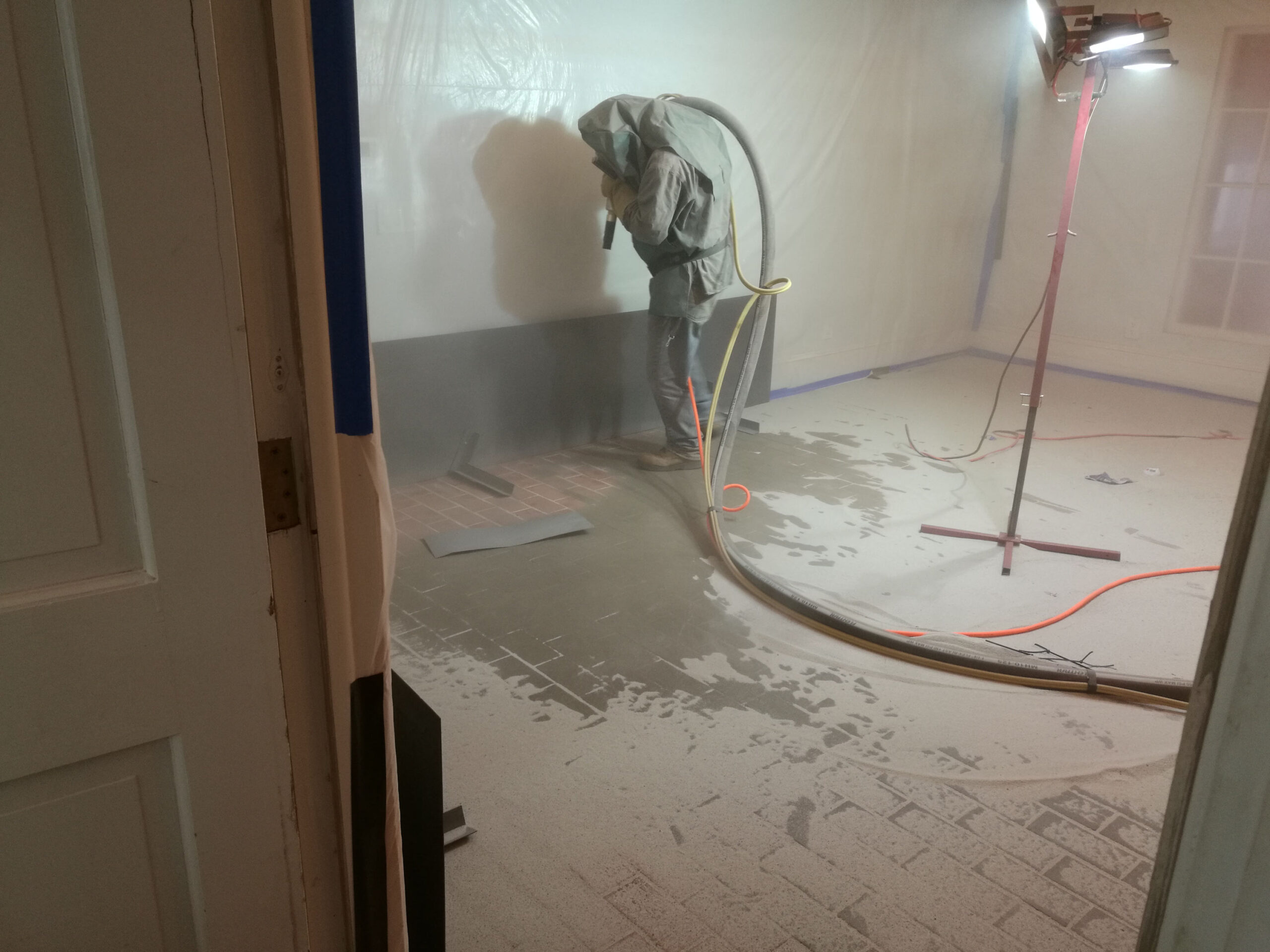
We blast brick around Lake City, Fort White, Live Oak, Branford and White Springs — chimneys, exterior walls, warehouse brick off US-90, and yes, living room fireplaces. This is what we tell homeowners standing in their own living room, before anybody takes a deposit.
1. Sandblasting a Brick Fireplace Is Really a Mortar Job
Everybody focuses on the brick face. The brick is not the fragile part. Fired brick has a hard outer skin from the kiln, and under that skin it is soft, porous and thirsty. The mortar between the bricks is softer still, especially on older Columbia County houses where the joints were struck with a lime-heavy mix.
Blast too hot and you do two things at once. You cut through the brick’s fire skin, which leaves a rough, chalky face that collects dust and darkens over the years. And you scour the mortar joints back a quarter inch, which turns crisp joints into shadowy trenches. Both are permanent. There is no putting a fire skin back on a brick.
So the job is not “remove paint.” The job is “remove paint while leaving the brick skin and the mortar profile intact.” That is a much narrower target, and it is why pressure, media and nozzle distance get set on a test patch behind the mantel before anybody blasts the wall you look at every night.
2. Test the Paint Before You Test the Brick
If the house went up before 1978 — and plenty of Lake City housing stock did — assume the paint has lead in it until a test says otherwise. Lead paint indoors is not a formality. Blasting turns a stable painted surface into airborne dust inside the room where people sleep and eat. The EPA’s Renovation, Repair and Painting rules exist for exactly this situation, and OSHA’s abrasive blasting standards cover the containment and respiratory side for the crew.
A cheap swab test from the hardware store answers the question in ten minutes. If it comes back positive, the honest options narrow: full containment with negative air and HEPA capture, or leave the paint alone and repaint it a color you can live with. We will tell you straight which way we would go in your house. Sometimes the second one is the right answer, and it costs you nothing but a change of mind.
3. Sand Is the Wrong Media for Interior Brick
The word “sandblasting” is stuck to the trade, but nobody should be shooting silica sand at your living room wall. It is too aggressive for brick, it makes a dust cloud you will find on ceiling fan blades six months later, and the silica itself is a lung problem.
For interior fireplace brick, the media we actually reach for:
- Sodium bicarbonate (soda). The gentlest real option. Soda crushes on impact instead of cutting, so it lifts paint and leaves the brick skin and mortar alone. Water-soluble, which means cleanup is easier and overspray rinses out of grout. It is slow, and it is our first pick on any fireplace where the brick has visible character worth keeping. Soda blasting in Lake City is the same process we use on engines and delicate parts, dialed down further for masonry.
- Crushed glass, low pressure. Faster than soda and still fairly forgiving on hard-fired brick. Good on multiple thick coats where soda would take three days. Needs a careful hand near the joints.
- Wet or dustless blasting. Water in the stream knocks the dust down hard, which matters a lot indoors. It trades one problem for another — now you have slurry running down the hearth and onto the floor, and brick holds moisture for days. Dustless blasting earns its keep on exterior chimneys and rarely inside a finished room.
What we do not use: coal slag, garnet, or anything with real bite. Those are steel abrasives. They belong on a trailer frame, not a fireplace.
4. Containment Is Most of the Work
Here is the part nobody puts in the video. Blasting the fireplace takes a few hours. Building the room to blast it in takes most of a day.
A proper interior setup means plastic from ceiling to floor, taped seams, doorways sealed with zipper flaps, HVAC returns shut off and covered so dust does not ride the ductwork into every bedroom, floors protected in layers, and a HEPA vacuum running to pull air out of the enclosure instead of pushing it into the house. Windows get sealed, not opened.
If somebody quotes you a fireplace blast and does not mention containment, they are planning to clean your house with a shop vac and hope. Florida humidity makes it worse — damp brick dust smears instead of sweeping, and it sets into grout lines and unfinished wood. We would rather spend the extra half day hanging plastic than spend a week apologizing.
5. Know What the Brick Will Look Like Underneath
This is the expectation talk, and it saves more heartache than any technique.
Paint was often applied to brick because the brick was ugly. Mismatched salvage brick, patched repairs in a different color, smoke staining above the firebox, efflorescence bloom from an old moisture problem — paint hides all of it. Take the paint off and you get the honest wall, not the magazine wall.
Second: paint that soaked into porous brick does not fully leave. On soft, absorbent brick you will get ghosting — faint pale haze in the pores that no amount of extra blasting removes, because removing it means removing brick. A good operator stops there on purpose. An operator chasing a perfect result keeps going and eats the face off your fireplace.
Third: mortar and brick almost never come clean at the same rate. Expect the joints to read lighter than the brick when the dust settles. That is normal and it mellows.
We shoot a test patch first, in a spot nobody looks at, and we show you the actual result before we commit the whole wall. If what comes up is not what you wanted, you have lost a square foot instead of a fireplace.
6. When We Tell You Not to Blast
We turn down fireplace work, and these are the usual reasons.
Soft handmade or sand-struck brick. If a key scratches the face easily, blasting will scour it no matter how gentle we get. Chemical poultice stripping is slower and messier and it is still the better tool for that wall.
Crumbling mortar. If joints are already sandy and dropping grit when you brush them, the fireplace needs repointing before anything else. Blasting a wall with failed mortar just makes the failure obvious faster.
Firebox interiors. The brick inside the firebox lives with heat cycling and creosote. That is a chimney professional’s territory, not ours.
A single coat of latex on hard, modern brick, in a room you can strip yourself over a weekend. If a chemical stripper and a stiff nylon brush will do it, we will tell you. The honest no earns the next yes.
What Happens After the Paint Comes Off
Bare interior brick is porous and it stays that way. Most homeowners want it sealed — a breathable masonry sealer, matte, so it does not read like wet plastic. Some want it left raw. A few want a limewash or German schmear over the newly clean brick, which is much easier to control on stripped brick than on painted brick.
We handle the blast and the finish with the same crew on the same job, which is the whole point of doing it this way. No waiting two weeks for a second contractor to look at our work and blame us for it. Our brick and masonry blasting service covers fireplaces, chimneys, exterior walls and commercial storefronts, and our painting and coating work picks up right where the blasting stops.
The rig comes to your driveway. We look at the actual fireplace, scratch-test the brick, swab the paint, and tell you what we would do if it were our own living room — including “leave it alone and paint it a better color,” when that is the truth.
Need sandblasting in Lake City or nearby? Call (386) 400-1904 for a free on-site estimate. You will reach someone who actually does the work.